Design Org & AI Workflow
Building the Organizational Foundation and Infrastructure — and Leading It into AI
Role
Director through AVP, Design Leadership (2007–2026)
Scope
Research · UX/UI · 3D Art & Sound · Design Ops · Workflow
Coverage
HTC Sense · OMNI Design System · VIVE Reality System · VIVERSE · VIVE Eagle AI Glasses

CONTEXT
Leading design through constant change
19 years at HTC was a journey of sequential transformations. I led the design organization through three product identities — smartphone, spatial computing, and AI wearables — across two Google acquisitions and multiple global leadership transitions. Throughout all of it, the team had to keep shipping quality products. The constant beneath the change was the design leadership and the infrastructure that sustained delivery, regardless of the business shifts.
DESIGN LEADERSHIP
Building the organization
I joined HTC in 2007 to lead a Taiwan-based team focused on UI design and production execution. Over the smartphone era, the team scaled to a peak of 40+ specialists across UX, UI, research, motion, and production design. Through two Google acquisitions and successive leadership transitions, I integrated the North America design group into a unified global UX design organization in June 2025.
The most durable output was never any single product — it was the infrastructure that made every product possible: the OMNI Design System, the spatial UI architecture, the OOBE framework, and the delivery workflows. As primary UX advisor through those transitions, I held a consistent mandate to provide design continuity when organizational structures were uncertain. The leadership culture, design methodologies, and systematic thinking were what made the team ready to lead into AI when the moment came.
LEADING INTO AI
From roadmap to AI-native practice
The AI design roadmap
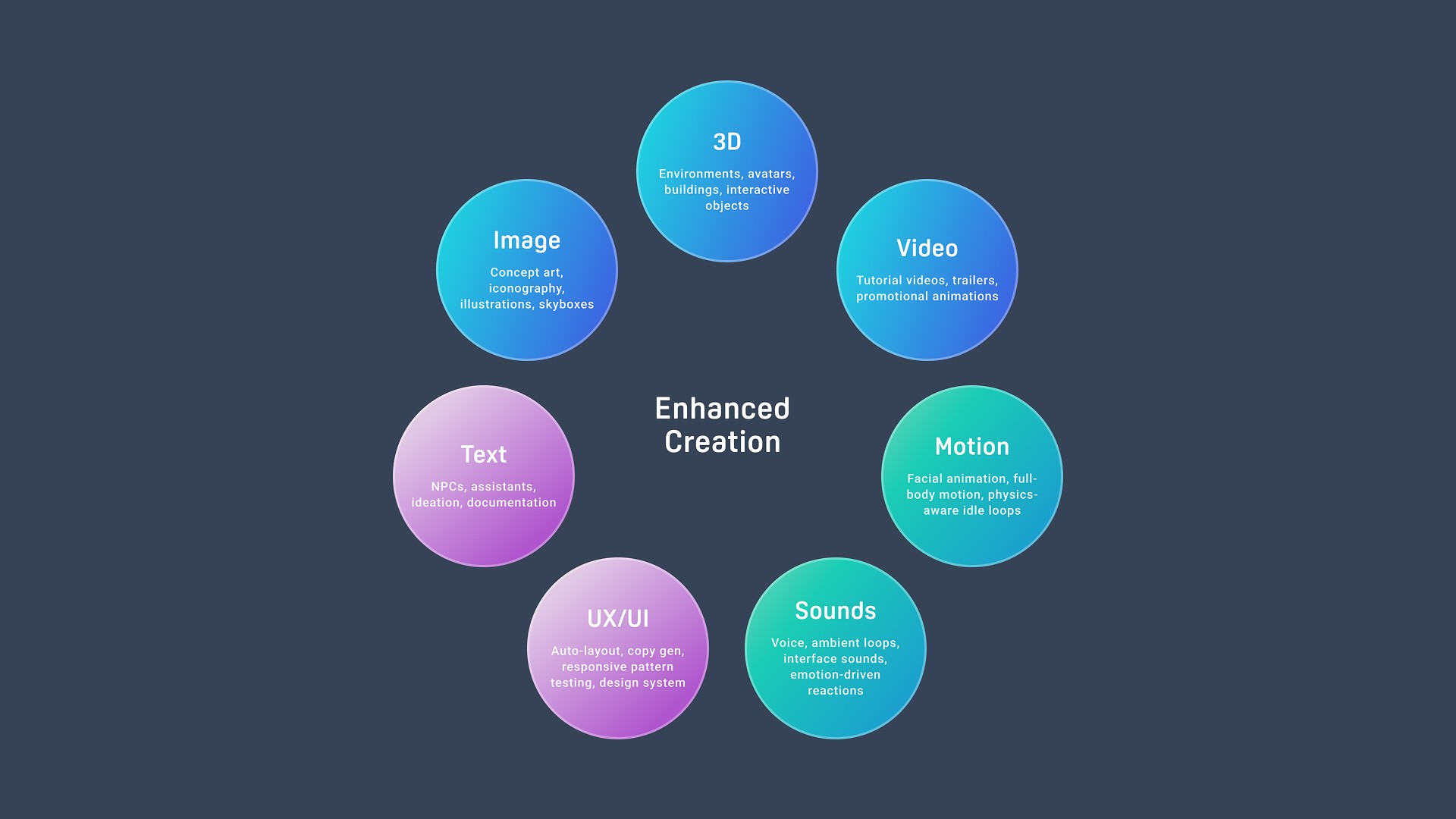
As generative AI became relevant to design practice, I led the team's research into AI workflows and tooling — evaluating which parts of the design process — across each product category — AI could meaningfully accelerate or extend. The roadmap we established connected AI adoption directly to the VIVERSE platform and content creation, grounding the work in real product problems rather than abstract experimentation.
Systematic theme design with AI
Originally built for HTC's company-wide AI hackathon, I led the team to architect modular, structured 3D scenes that integrate multiple AI-generated outputs into coherent immersive environments. The project won the company prize, and we phased the approach into VIVE XR Elite in post-production.

3D character design with AI
3D character creation is a multidisciplinary process — modeling, rigging, body animation, and facial expression systems. We evaluated AI tools across each stage and rebuilt the workflow so artists could generate high-quality variants in a short lead time. We shipped a series of AI robot characters to VIVERSE, compatible with VRM.

Product design with AI
Across scaled product design and deep engineering complexity, accelerating the design process with AI was a constant consideration. I led the team to evaluate tools for generating design materials and to train data models for design testing — and I see the next evolution of OMNI becoming a functional library that links shared components directly to the engineering codebase.
OUTCOME
What organizational investment makes possible
Design leadership is fundamentally about building the infrastructure, culture, and systems that make quality possible for a team — built for the company's long-term growth, not just the product in front of you. Across nineteen years and three technology eras, the chance to build platforms and design systems at scale was rare. The lasting achievement isn't any one of them; it's the organizational capability that produced them, built with the team.